The Receipts Portfolio: Why the Messy Middle Is the Only Thing AI Can't Fake
There's a moment in every portfolio review where the whole thing turns. It used to arrive near the end, when you'd ask some version of "so, what do you think?" In 2026, it lands about eleven seconds in — right when the person across the table realizes they can't tell whether you made the thing or prompted it.
That's not a compliment problem. It's a documentation problem.
A finished artifact used to carry weight simply by existing. Getting to a clean hero image, a workable landing page, a competent campaign mock — that took hours, software, a decent eye, and a fair amount of stubbornness. A clean result was itself evidence of effort. That's no longer true. Clean is now a starting condition. Which means the only question your portfolio genuinely has to answer is smaller and much harder: what did you actually do?
The Floor Moved, Quietly
Nobody sent a memo. There was no single week where portfolios stopped working. But ask anyone who's hired creative work in the last couple of years and they'll tell you the same thing: the middle of the pile has gotten indistinguishable. Not bad — indistinguishable. Two hundred competent deliverables that all look like they came from the same very polite, very safe place.
What breaks the tie now isn't a better finish. It's how the person thinks when the work isn't going well yet.
That's the part that's genuinely difficult to fake at scale. Anyone can produce artifact number two hundred and one. Almost nobody can produce the sketch where you were wrong for two days, the note where you talked yourself out of the obvious solution, or the client email where you pushed back on a request that would have made the project worse.
What Reads as Human Now
The instinct is to swing hard the other way — dump the whole project folder online and call it transparency. That's not a portfolio, it's a hard drive with a URL. Reviewers don't want archaeology. They want evidence, delivered fast.
What actually lands, in my experience and in a lot of conversations with people who hire for creative roles:
- A fork in the road. Not every decision you made — one decision where a sane person could have gone the other way.
- A visible cost. Something you gave up. A direction that got cut, a clever bit that confused real users, a scope you fought to shrink.
- A human trace. A sentence from a client, a teammate, or a user that changed your mind. Verbatim beats paraphrase.
- Your own handwriting, metaphorically. The phrasing, the hedging, the weird comparison you'd only make if you were tired. Voice is a fingerprint.
Notice what's not on that list: process screenshots for their own sake, timelines nobody reads, and the twenty-step workflow diagram that makes you look organized rather than interesting.
The Four-Artifact Rule
Here's the framework I keep coming back to. For any project you want to lead with, include four artifacts and nothing more unless there's a real reason:
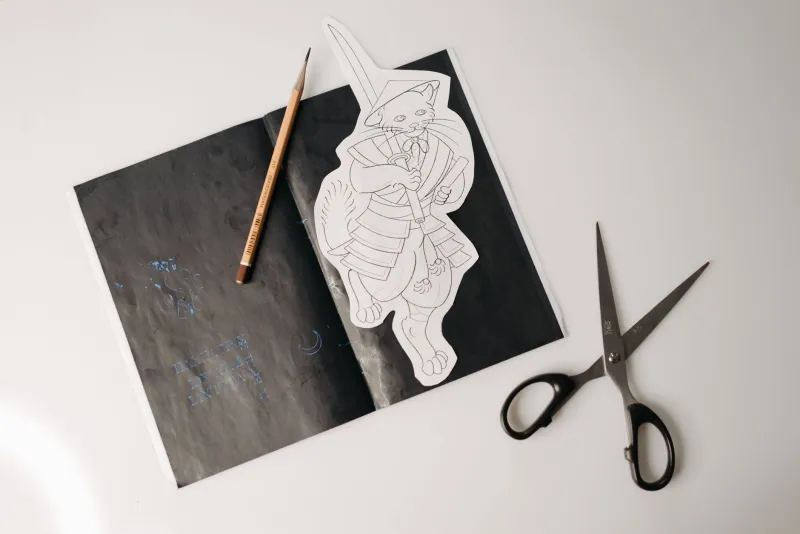
- One early sketch. The roughest thing that shows the idea before it was good. Hand-drawn, half-formed, unflattering. This is your credibility deposit.
- One rejected direction. Show a path you abandoned and say in a single sentence why. This proves judgment, which is the thing a portfolio is really for.
- One decision note. Two or three sentences of your actual reasoning at the moment of choosing. Written at the time if possible. Reconstructed is fine — but say so.
- One piece of friction. A constraint, a comment, a conflict, a budget. Something that pushed back on you.
That's it. Four artifacts, maybe a dozen sentences of connective tissue. If a reviewer can't get through it in ninety seconds, it's not evidence anymore — it's a chore.
Where It Belongs, and Where It Doesn't
The mistake I see most often is burying good context in a PDF appendix or a process subfolder that no human will ever open. Put the receipts on the main path — right next to the finished piece, not three clicks away. The finished work earns attention; the receipts convert it.
What you can leave out: anything that's only interesting to you. The stack of tools. The day-by-day log. The version history. Your portfolio is an argument, not an archive, and arguments are won by selection.
The Ninety-Second Test
Before you publish, hand the project page to someone who doesn't work in your field. Give them ninety seconds. Then ask two questions:
- What did this person actually do?
- What did they decide that someone else might not have?
If they can answer both, you're done. If they can only answer the first — nice artifact, unclear author — you've built a portfolio for a world that stopped existing a couple of years ago.
The finish was never the point. It just used to be the only thing anyone could see.